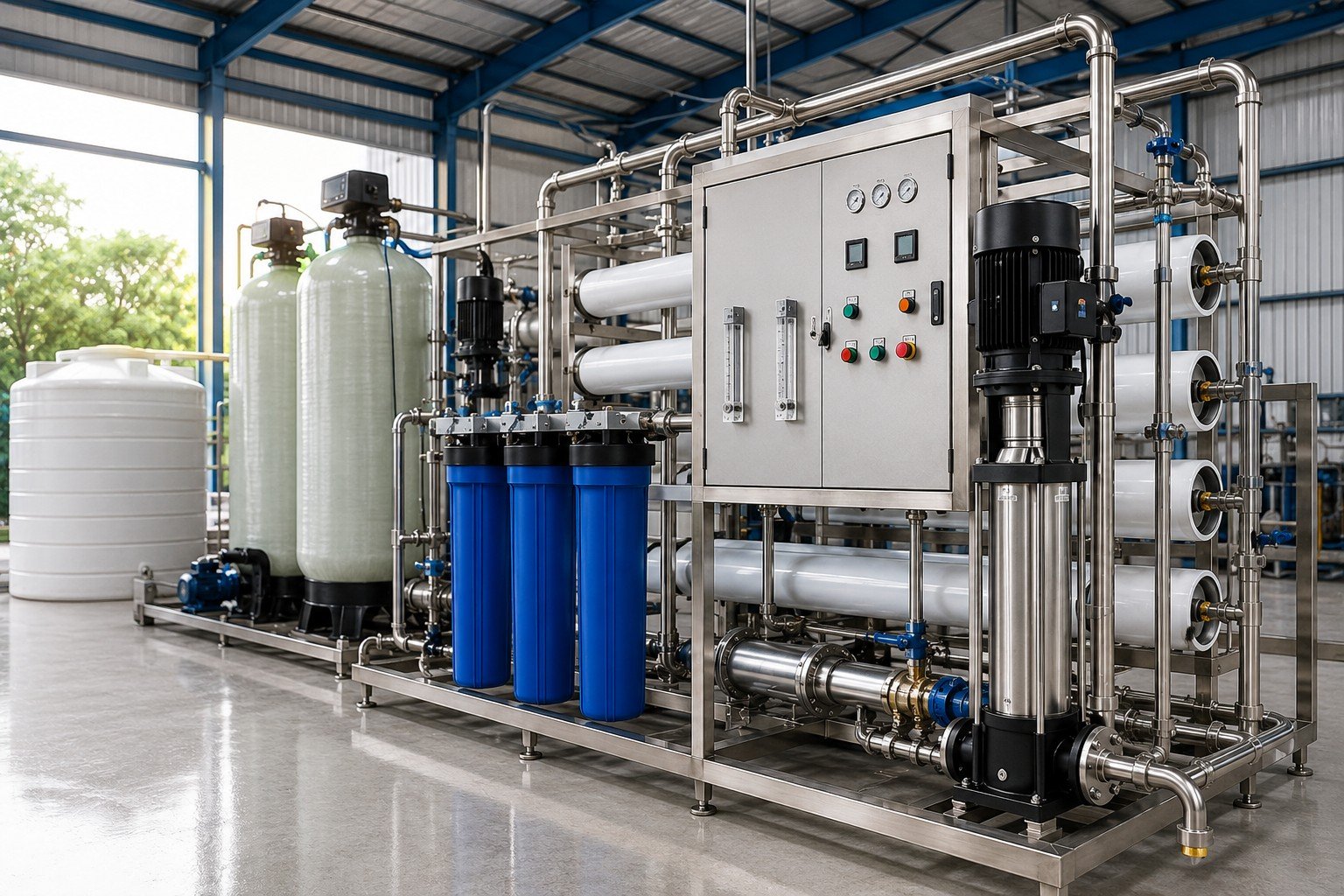
Choosing the right industrial RO plant capacity is essential for factories that need a reliable supply of purified water. A system with insufficient capacity may interrupt production, while an oversized plant can increase equipment costs, electricity consumption, and maintenance expenses. The ideal solution depends on daily water demand, operating hours, raw water quality, and the purity required for your manufacturing process.
AToZ Enterprises offers industrial RO plant options for businesses evaluating water treatment solutions. Before selecting a system, understanding your actual consumption and technical requirements can help you make a cost-effective, informed decision.
1. Calculate Your Factory’s Daily Water Demand
The first step is to determine how much purified water your factory needs each day. Consider manufacturing processes, equipment cleaning, product preparation, boiler feed, and other applications that specifically require RO-treated water.
Separate these requirements from general water consumption, such as gardening or cooling, where different treatment methods may be appropriate. Review water meter readings, production records and consumption patterns across different shifts to estimate daily demand accurately.
For example, a factory requiring 12,000 litres of purified water daily should use this figure as the starting point for capacity planning. However, daily consumption alone does not determine the final plant size.
2. Understand LPH and KLD Capacity
Industrial RO plants are commonly specified in litres per hour (LPH) or kilolitres per day (KLD). LPH indicates the hourly production rate, while KLD represents daily output under specified operating conditions.
Use this formula to estimate the required production rate:
Required LPH = Daily purified water demand ÷ Operating hours per day
Suppose your factory needs 12,000 litres daily and the plant operates for 10 hours.
12,000 ÷ 10 = 1,200 LPH.
This gives you a baseline requirement of 1,200 litres per hour. The final specification should account for peak demand, downtime and the manufacturer's rated output under your actual feed-water conditions.
3. Allow for Peak Demand and Future Expansion
A factory rarely consumes the same amount of water every hour. Production batches, cleaning schedules and shift changes can create periods of higher demand.
When evaluating capacity, consider:
-
Peak demand: Identify the hours when water consumption is highest.
-
Maintenance downtime: Account for scheduled servicing and membrane cleaning.
-
Storage capacity: Determine whether a treated-water tank can supply water during temporary demand spikes.
-
Future growth: Estimate whether production volumes or water requirements will increase.
A plant producing enough water on paper may still be unsuitable if its output cannot meet operational demand. An engineering assessment can help determine whether additional production capacity or storage is the more practical solution.
4. Assess Raw Water Quality Before Installation
Raw water quality directly affects RO plant design, pretreatment requirements, and membrane performance. Borewell and industrial water sources may contain different concentrations of dissolved salts, hardness, iron, silica, and suspended particles.
A high total dissolved solids (TDS) reading alone cannot establish the complete treatment requirement. A laboratory water analysis helps identify the pretreatment stages, membrane configuration, and operating conditions needed for your application.
When comparing an industrial ro plant gurgaon supplier, request a design based on your actual water analysis rather than a standard configuration. Confirm the expected product-water quality, production rate, and operating parameters before approving the installation.
5. Evaluate Water Recovery and Running Costs
RO recovery rate is the percentage of incoming feed water converted into purified water. The remaining water becomes the reject stream, which contains concentrated dissolved substances.
For example, at an assumed recovery rate of 70%, producing 12,000 litres of purified water would require approximately 17,143 litres of feed water. Actual recovery depends on water chemistry, membrane design, and scaling limitations.
Purchase price is only one part of the overall investment. Compare electricity consumption, membrane replacement, filter changes, chemical requirements, maintenance, and reject-water management.
A properly designed industrial ro filter in gurgaon installation should include suitable pretreatment to protect the RO membranes and support consistent operation. Ask suppliers to explain the expected maintenance schedule and recurring costs.
6. Match the Plant to Your Industry
Different industries require different water quality standards. Food processing, pharmaceuticals, textiles, automotive manufacturing and general engineering may have distinct requirements for treated water.
For example, certain manufacturing processes need additional polishing after RO treatment, while boiler feed applications may require further treatment according to boiler specifications. The required configuration should therefore be determined by the end use, not capacity alone.
Businesses comparing an RO plant industrial Gurgaon solution should confirm the necessary water parameters with their production or quality team. This helps ensure the selected system can deliver the required quantity and quality of water.
7. Compare Suppliers, Specifications and Installation Support
Before purchasing, request a detailed quotation covering the RO unit, pretreatment filters, pumps, membranes, control panel, installation, and commissioning. Confirm the warranty, spare-parts availability, maintenance support, and site requirements.
If you are comparing an RO plant industrial Gurgaon option, evaluate the complete technical specification rather than choosing solely on price. Ask how the proposed system will perform with your feed-water quality and daily demand.
AToZ Enterprises lists industrial RO plant capacities ranging from 250 and 500 LPH to 1,000, 2,000 and higher-capacity options. Businesses looking for an industrial ro water plant gurgaon can assess the available models against their calculated demand, installation conditions and future requirements.
The best system is one that consistently meets your water-quality requirements while maintaining manageable operating costs.
Final Thoughts
Choosing the right industrial RO plant capacity requires more than estimating daily water consumption. Consider operating hours, peak demand, feed-water quality, recovery rate, industry-specific requirements, and future expansion before making a decision.
For businesses planning an installation, a water analysis and a detailed technical assessment provide a stronger basis for selecting the right system. Contact AToZ Enterprises to discuss your factory’s water treatment requirements and evaluate suitable industrial RO plant options.
FAQs
1. How do I calculate industrial RO plant capacity?
Divide your daily purified-water requirement by the number of operating hours. Then account for peak demand, maintenance downtime and actual system performance before finalising the capacity.
2. Which capacity is suitable for a small factory?
The required capacity depends on consumption and operating hours. A 250, 500 or 1,000 LPH system may suit some smaller facilities, but water-demand calculations and raw-water testing are necessary before selection.
3. Does high-TDS water affect industrial RO plant selection?
Yes. High TDS can influence membrane selection, operating pressure, recovery and pretreatment requirements. A laboratory water analysis helps determine the appropriate design.
4. What is the difference between LPH and KLD?
LPH measures hourly output, whereas KLD measures daily production in kilolitres. A plant producing 1,000 litres per hour for 10 hours would theoretically produce 10 KLD under those operating conditions.
5. How can I choose an industrial RO plant supplier in Gurgaon?
Compare suppliers based on water analysis, capacity calculations, equipment specifications, installation scope, warranty, and after-sales support. Request a technical assessment before confirming your purchase.